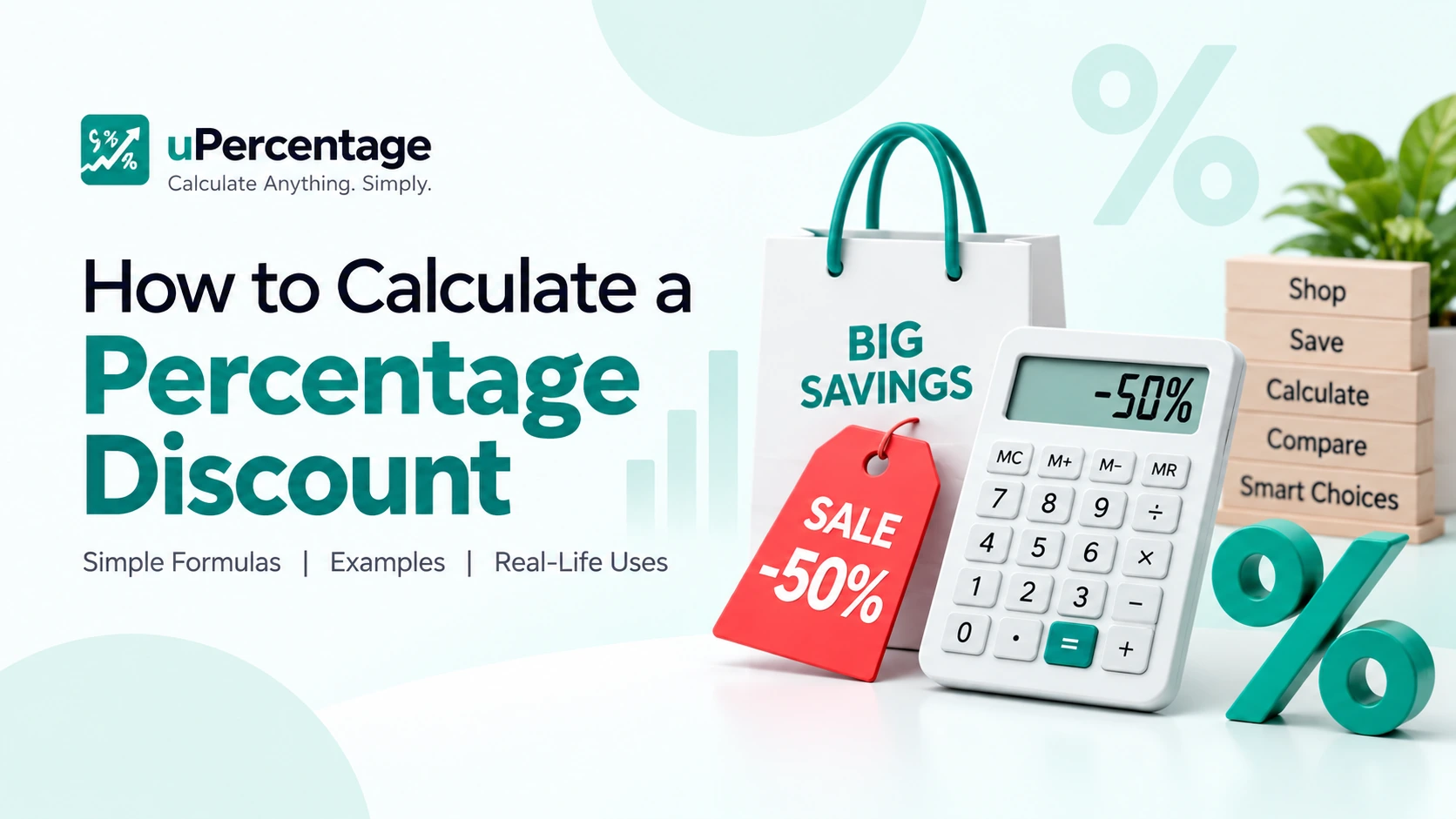
How to Calculate a Percentage Discount
How to Calculate a Percentage Discount
Percentage discounts are commonly used when shopping, comparing prices, calculating sale prices, and managing business promotions. Whether a store offers 10% off, 25% off, or 50% off, the calculation follows a simple formula.
Understanding how percentage discounts work helps you quickly determine how much money you will save and how much you will actually pay.
You can also use the Percentage Discount Calculator on uPercentage to calculate discounts instantly.
What Is a Percentage Discount?
A percentage discount represents the amount deducted from an item’s original price.
For example, if a $100 product has a 20% discount:
- Original price = $100
- Discount = 20%
- Discount amount = $20
- Sale price = $80
So, a 20% discount means you pay 80% of the original price.
How to Calculate a Percentage Discount
To calculate the discount amount, multiply the original price by the discount percentage.
For example, suppose a jacket costs $80 and is discounted by 25%.
First, convert 25% to a decimal:
25 ÷ 100 = 0.25
Then multiply:
$80 × 0.25 = $20
The discount is $20.
To find the final price:
$80 − $20 = $60
So, the jacket costs $60 after the discount.
For a quick calculation, you can use the uPercentage Percentage Discount Calculator.
Percentage Discount Formula
The basic formula is:
Discount Amount = Original Price × (Discount Percentage ÷ 100)
To calculate the final sale price:
Sale Price = Original Price − Discount Amount
You can combine both steps into one formula:
Sale Price = Original Price × (1 − Discount Percentage ÷ 100)
Example
An item costs $250 and has a 15% discount.
Discount Amount = $250 × (15 ÷ 100)
Discount Amount = $37.50
Then:
Sale Price = $250 − $37.50
Sale Price = $212.50
The customer saves $37.50 and pays $212.50.
Percentage Discount Examples
Example 1: 10% Discount
Original price: $100
Discount: 10%
Discount amount:
$100 × 0.10 = $10
Final price:
$100 − $10 = $90
You save $10 and pay $90.
Example 2: 25% Discount
Original price: $200
Discount: 25%
Discount amount:
$200 × 0.25 = $50
Final price:
$200 − $50 = $150
You save $50.
Example 3: 50% Discount
Original price: $120
Discount: 50%
Discount amount:
$120 × 0.50 = $60
Final price:
$120 − $60 = $60
A 50% discount reduces the original price by half.
How to Calculate the Sale Price After a Discount
There is a quick way to calculate the final price without calculating the discount amount separately.
If an item has a 20% discount, you pay:
100% − 20% = 80%
So you can simply calculate:
Original Price × 80%
For example:
$150 × 0.80 = $120
Therefore, a $150 item with a 20% discount costs $120.
How to Calculate the Original Price From a Discounted Price
Sometimes you know the sale price and discount percentage but want to find the original price.
The formula is:
Original Price = Sale Price ÷ (1 − Discount Percentage ÷ 100)
For example, suppose a product costs $90 after a 10% discount.
You paid 90% of the original price.
Therefore:
Original Price = $90 ÷ 0.90
Original Price = $100
So the original price was $100.
Percentage Discount vs. Percentage Decrease
Percentage discount and percentage decrease can sometimes look similar because both involve a reduction in value.
However, they are commonly used in different situations.
A percentage discount usually describes a reduction in the price of a product or service.
A percentage decrease describes a reduction in a value more generally.
For example:
- A store gives 30% off a pair of shoes → percentage discount
- A company’s expenses fall by 15% → percentage decrease
- A product’s price drops by 10% → could be described as either a discount or percentage decrease depending on the context
You can use the Percentage Decrease Calculator when you want to measure how much a value has decreased.
Where Are Percentage Discounts Used?
Percentage discounts are used in many everyday situations, including:
Shopping
Retailers frequently advertise discounts such as 10%, 20%, 30%, or 50% off.
Online Stores
E-commerce websites often use percentage discounts during seasonal sales and promotional campaigns.
Business Promotions
Businesses may offer discounts to attract new customers or encourage larger purchases.
Memberships and Subscriptions
Some services offer percentage discounts for annual plans, memberships, or special promotions.
Clearance Sales
Stores often use large percentage discounts to reduce inventory.
Understanding the calculation makes it easier to compare deals instead of relying only on the advertised discount.
How to Calculate Discounts Quickly
For quick calculations, convert the percentage into a decimal.
For example:
- 10% = 0.10
- 15% = 0.15
- 20% = 0.20
- 25% = 0.25
- 50% = 0.50
Then multiply the original price by the decimal.
For example:
$80 × 0.25 = $20
So a 25% discount on $80 saves you $20.
If you regularly calculate discounts, the Percentage Discount Calculator can do the calculation for you instantly.
Common Discount Calculation Mistakes
One common mistake is forgetting to convert the percentage into a decimal before multiplying.
For example, 20% should be written as 0.20, not 20.
Another common mistake is confusing the discount amount with the final sale price.
For example, if a $100 item has a 20% discount:
- Discount amount = $20
- Final price = $80
The $20 is the amount saved, while $80 is the amount you pay.
It is also important to remember that discounts are usually calculated from the original price unless the promotion specifically states otherwise.
Frequently Asked Questions
Find quick answers to common questions about percentage discounts, sale prices, and calculating savings.
How do I calculate a percentage discount?
To calculate a percentage discount, multiply the original price by the discount percentage divided by 100. For example, a 20% discount on a $100 item is $20, so the final price is $80.
What is the formula for percentage discount?
The basic formula is Discount Amount = Original Price × (Discount Percentage ÷ 100). To find the final price, subtract the discount amount from the original price.
How do I calculate the final price after a discount?
Subtract the discount amount from the original price. For example, if an item costs $200 and has a 25% discount, the discount is $50, so the final price is $150. You can also use our Percentage Discount Calculator to calculate it instantly.
How do I calculate a 20% discount?
Multiply the original price by 0.20 to find the discount amount. For example, a 20% discount on $150 is $30. Subtract $30 from $150 to get a final price of $120.
How do I calculate the original price from a discounted price?
Divide the discounted price by the percentage you paid after the discount. For example, after a 10% discount, you pay 90% of the original price. If the sale price is $90, divide $90 by 0.90 to get an original price of $100.
What is the difference between a discount and a percentage decrease?
A percentage discount usually refers to a reduction in the price of a product or service, while percentage decrease describes a reduction in a value more generally. The mathematical calculation can be similar, but the terms are commonly used in different contexts.
How much do I save with a 50% discount?
A 50% discount means you save half of the original price. For example, if an item originally costs $80, a 50% discount saves you $40 and the final price is $40.
Is the uPercentage Percentage Discount Calculator free?
Yes. The uPercentage Percentage Discount Calculator is free to use and requires no registration. It helps you quickly calculate the discount amount and final price.